Sat on a Chair
Sat on a Chair In Sat on a Chair, I use my body to examine endurance, vulnerability, and the psychological experience of height. Bound to a chair atop a tall pillar for three hours, I remained suspended between stillness and risk, inviting the audience to confront feelings of vertigo, empathy, and uncertainty. During the performance, a sudden rain shower left me completely exposed, yet I continued without interruption. Viewed simultaneously from the ground floor and the third floor, the work transformed architectural space into a field of tension, where silence became an active form of communication. Through physical endurance and sustained stillness, I sought to create a shared experience of contemplation, exploring the fragile relationship between the body, gravity, and perception.. 2014Duration: 3 hours Dhaka Art Summit 2014, curated Mahbubur Rahman
The Dress of Tipu Sultan
A Tailor is sewing the dress of Tipu Sultan A two-day performance by Yasmin Jahan Nupur, a leading contemporary artist from Bangladesh. In this performance, Nupur uses specially handwoven muslin-jamdani as a signifier of power and consumption embedded in the contested and violent history of the subcontinent. A highly revered, translucent cotton cloth from Bengal, muslin embellished with jamdani (woven pattern) has been celebrated over the centuries for its mesmerising allure and feather-light texture, often compared to moonlight or the morning dew. This fine cloth made from a labour-intensive process historically adorned the richest of rulers in the subcontinent and attracted a lucrative overseas trade. This performance will take place alongside Nupur’s works on display in the exhibition, Beyond Borders, connecting the rich and complex history of muslin and jamdani. Growing up in Bangladesh Nupur was aware of how muslin had been celebrated across the world but equally, was deeply affected by the legacies and impact of British colonialism. “There are entire generations of Bengali men and women who have grown up with legendary stories of how the British cut off the thumbs of weavers so they could no longer produce muslin and were forced to buy British goods. This history constantly hurts me”. The 18 th century saw significant political, social and economic changes to the subcontinent. It was a time when the area, which once incorporated Pakistan and Bangladesh, (amongst other South Asian countries) was under the administrative control of the British East India Company. Numerous battles were fought and aggressive advances were made to dominate and control trade. During this time, the British East India Company secured trading rights in Bengal, establishing a factory in Dhaka and many others in Bengal. They strictly controlled the production of muslin. By the end of the 18 th century the production was in decline. Many factors contributed to this such as famine, poverty, taxes and competition from British goods. In the late 18 th century Tipu Sultan was known as a fearless and great ruler of Mysore in Southern India, resisting the advances of the British East India Company. During his reign (1782-99) he built magnificent palaces and amassed a great fortune in jewellery, precious gems and ornaments. He was also known for his love of fine clothing including the finest muslins and jamdanis from Bengal. In 1799 Tipu Sultan was killed in the Battle of Srirangapatna (Seringapatam) by the British East India Company which was heralded by them as a triumph. The officers subsequently looted his palaces, resulting in colonial booty eventually making its way into a great number of British national collections where they can still be seen today. Nupur uses muslin/ jamdani as a medium to locate and express these individual and collective memories across time and place. This fine texture conceals and reveals, dissects and unites the space we occupy. The act of weaving is meditative, physical and emotional. The entire body of the weaver is invested into its formation. The fineness of muslin forms a second skin, connecting our bodies and spirit with the woven structures of the universe. Situating the performance in the textile gallery at the Whitworth, Nupur translates these conflicted histories, working silently and industriously, oscillating between the absence and presence, the marginalised craft-maker and glorified victor. Part of the New North and South programme. Read More Part of the New North and South programme.
A Flying Seed and A Bird Named Hiramon
A Flying Seed and A Bird Named Hiramon The Spore studio is transformed by a performative conversation with Yasmin Jahan Nupur , complementing her handwoven soft sculptures and engaging visitors with ” A Flying Seed and a Bird Named Hiramon ” – an intimate moment of storytelling that encourages the audience to relax, connect and immerse oneself in conversations about childhood, memories of forgotten places, rivers and emotions, communal experiences of home, migration and changing ecology. Since storytelling played an important role in Yasmin’s childhood, a key part of her work involves interacting with children and people of all ages to revisit almost forgotten fairy tales and breathe new life into them. Spore Initiative, Berlin. 16th and 17th September 2023(8 hours performance)
Words and Hope
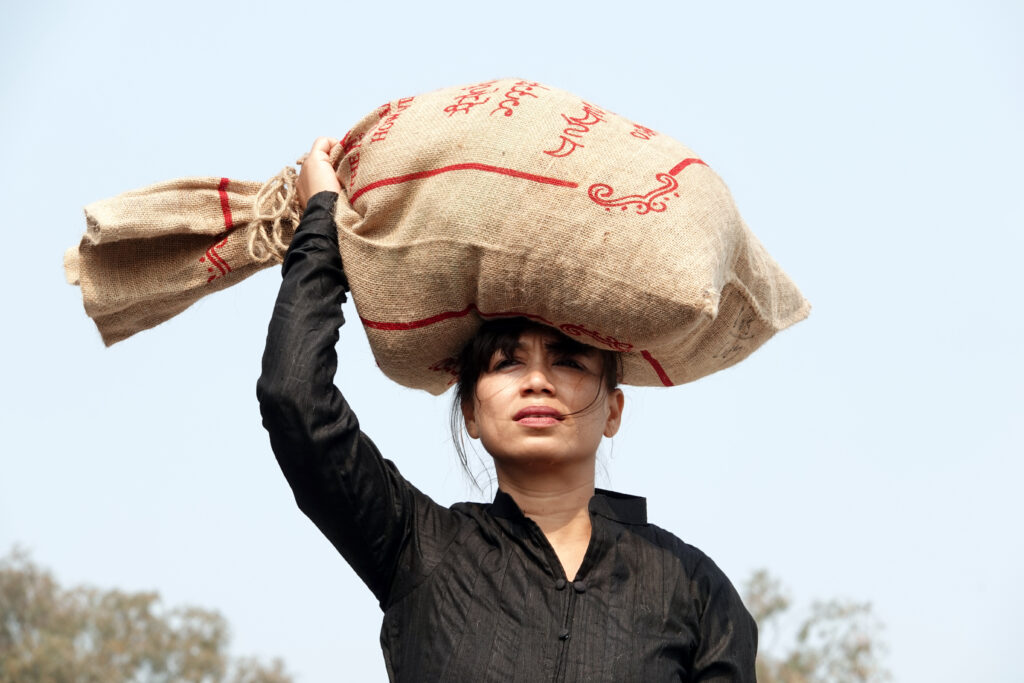
Words and Hope In this performance, I explored the mental and emotional spaces that open up during moments of exchangewithin human relationships. The foundation of the work was the creation of human and political statementsthrough experimental, interactive settings in which contact served as a platform for introspection, research, andself-examination.The central concerns of this project were those of limits and boundaries, both psychological and physical. Ilooked at the potential and constraints of communication, the politics of seeds and land, and the possibilities andlimitations of communication between familiar and unfamiliar languages. Performance Feb 1–2, 20199 hrs total” “India Art Fair (IAF), New Delhi, IndiaART India / JSW initiative”
Let Me Get You a Nice Cup of Tea
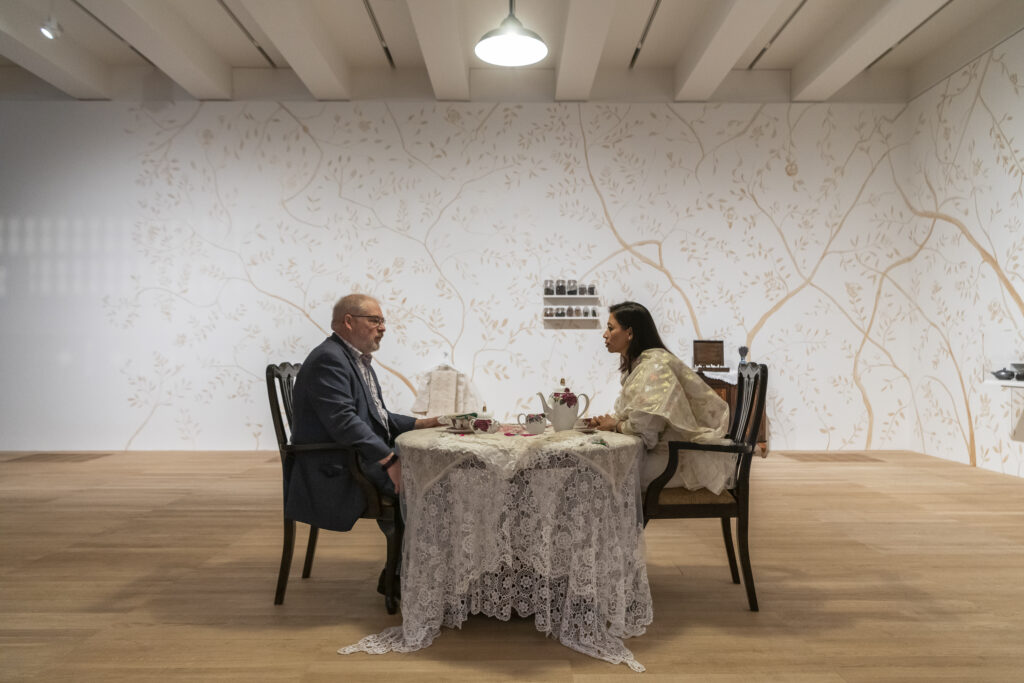
Let Me Get You a Nice Cup of Tea Tea originated in China, where it was first valued for its medicinal and spiritual qualities. Buddhist and Taoist monks drank tea to support meditation, drawn to its quiet strength and ability to sharpen attention. Over centuries, tea crossed borders and belief systems, eventually becoming one of the most widely consumed beverages in the world, second only to water. Europe’s fascination with tea in the early modern period transformed it into a global commodity. As Russians, Dutch, and British traders competed for control, tea became entangled with imperial ambition. In the 1830s, the British Empire began cultivating tea in India, initially using imported Chinese plants in Assam. Through the East India Company, Britain monopolized the tea trade, converting Indian land and labor into profit. By 1888, more tea was imported to Britain from India than from China. Tea fueled trade routes, colonial violence, and resistance—from the American Revolution to the Opium Wars—quietly shaping global histories while appearing harmless and domestic. Yet tea is more than a colonial product. In South Asia, it became woven into everyday life. In Bangladesh and India, tea is shared in homes and roadside stalls, marking pauses in the day and moments of connection. These rituals have largely been shaped and sustained by women, who transformed tea time into a space for hospitality, storytelling, moral instruction, and care across generations. As tea traveled, it absorbed local knowledge and taste. Cardamom, cinnamon, ginger, and sugar gave rise to masala chai and countless regional variations mint tea, chili tea, tamarind tea. In Bangladesh, tea shops become informal public forums where debate, grief, gossip, and laughter coexist. Tea calls people to stop, gather, and speak. This project takes the form of a public tea party performance. Drawing from the structure of British afternoon tea, I reconfigured it into an intimate, reflective gathering rooted in shared presence rather than hierarchy. I harvested and prepared the tea myself, grounding the work in labor, care, and intention. Serving tea becomes a performative act one that carries histories of colonialism, domestic labor, and resistance while opening space for dialogue. Through conversation over tea, participants reflect on what we consume, where it comes from, and the invisible hands and memories it contains. The tea party becomes a site of cultural memory and quiet transformation. Materials: Traditional Chinese teacups and saucers, antique teapot, handwoven tablecloths, wooden table and chairs, antique cabinet, eleven hand-harvested tea blends (traditional and experimental), Jamdani costume, wallpaper drawn with tea pigmen Read More Performance” “2019–2023London Frieze 2019; Dhaka Art Summit 2020; Tate Modern 2022–23″ “London, UK; Dhaka, BangladeshExhibit320 / Peabody Essex Museum commission”
The Touch
“The Touch Performance” The Touch;confronts the violent reality of borderlines, barbed wire fences that strong through land, memory ofthe land, and human connection. The performance compels the body to move through these imposed divisions,to experience how crossing or even approaching a border can strip away dignity, Violence, silence voices, andfracture relationships.Barbed wire becomes more than a material boundary; it becomes a psychological and emotional barrier. Toreach across it is to risk vulnerability. To speak across it is to confront distance, surveillance, and separation.The work embodies the tension of trying to touch, to communicate, to remain human in the face of systemsdesigned to divide.In this charged space, a simple gesture transforms into an act of resistance—an insistence on intimacy,exchange, and shared humanity despite the violence of separation. Kochi-Muziris Biennale Curator: Nikhil Chopra and HH Art Space, Date: 12/12/2025- 31March 2026, Venue: 111 Merkez, Fort Kochi. Support by Mubarak Foundation