Crossing the Border, Being together
Crossing the Border, Being together The adoption of national identity in terms of historical development has commonly been the result of a response by an influential group or groups that is unsatisfied with traditional identities due to inconsistency between their defined social order and the experience of that social order by its members, ensuing in a situation of social instability that nationalists seek to resolve. This development may be the result of internal structural issues or the result of resentment by an existing group or groups towards other communities, especially foreign powers that are or are deemed to be controlling them. In mid nineteenth century, three institutions of power have changed their form and function as the colonized zones entered the age of mechanical reproduction. These three institutions were the census, the map, and the museum together. Now nationalism is a political ideology that involves a strong identification of a group of individuals with a nation. History is a way that used the past to validate own beliefs. Histories are being corporate by nationalism, map, war, religion, globalization, political and identity. Every country has been defined by a map. Maps of the world generally focus either on 'political' features or on 'physical' features. Political maps emphasize territorial boundaries and human settlement. Every country divine by a line which call border. By politically we have to maintain the border. We cannot cross this line. Ever some countries are united but politically it has been changed and made a new map. This map includes in world map. As per the new map people are divine a zone, a country, a nation and have to maintain the line or border. Sometime these lines are going in the middle of the house. One part of this house is belonging one country and another part is belong to the other country. Now we all have our own national flags, national anthems, and other symbols of national identity which are commonly considered highly important symbols of the national community. Nationalism is commonly defined as a love for one's country. Throughout history, large groups of people who share a cultural identity (language, customs, history) have felt the pulling power of nationalistic feeling. The spirit of independence also includes the belief that one's nation is better off as an independent state. Independency is defined as a nation governing itself independently from a centralized point. Revolutions, wars, ethnic tension, and other conflicts of varying degrees have occurred throughout history because of a love for one's country. The spirit of nationalism has shaped the histories and destinies of many countries. Nationalism can unite people into cohesive, stable nations. But people have to habit to identifying oneself with a single nation. Through my project I can share and decentralize my work through history, socio-economic culture and wider community committed to the principles of human dignity and equality. Read More video, installation. 2013 and ongoing project, exhibited also 2017, 2024Material: Muslin (Jamdani) fabric. For Embroidery –needle, thread, red cotton, Wooden structure (8thft), one electronic machinery motor. (it helps to moving projector).55th Venice Biennale, Venice, Italy.2013 The National Pavilion of Bangladesh.
Home Participatory Installation
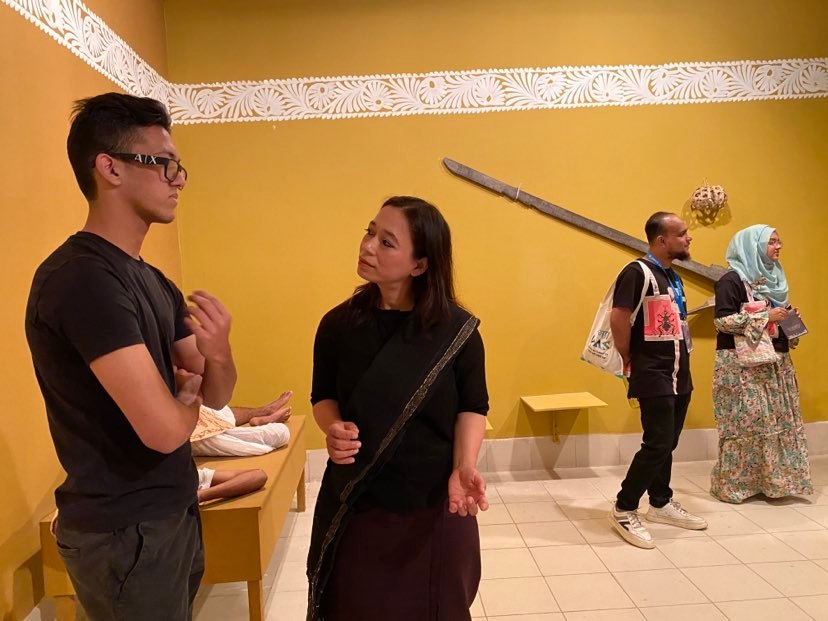
Home In my home project, I explored childhood not just as a memory, but as a place, a journey, and a transformative energy. I delved into the landscapes, people, stories, objects, and emotions that begin to fade as we grow older and drift away from the environments that once shaped us. This work based on my own experience of leaving my hometown and the devastating loss of my ancestral land in 2014 served as the inspiration for this very personal piece. Using this perspective, I developed a participatory installation that invited children, teens, and adults to come together, think, and share their personal tales and memories through guided conversations. In addition to reading aloud cherished stories from books like Thakumar Jhuli stories that have a strong generational resonance, I urged participants to reminisce about long-lost fruits, trees, scents, and other childhood object. I envisioned the space as an intimate, domestic setting where even the smallest emotions could be expressed, held, and heard. The installation invoked collective memories and the rural landscapes of my past by including performative components and suggestions derived from my research. Once a natural fence in my community, a big cactus with eye-catching blue blossoms is now reduced to a little potted plant. It evolved into a subdued, moving representation of continuity and change within the space. At the heart of the installation were a handmade play cart, costumes, and a collection of found and gifted objects that served as storytelling triggers. These elements shaped a fluid, living social space that evolved throughout the exhibition. To hold and expand these conversations, I worked closely with a group of young artists who served as mediators. Together, we facilitated dialogue, documented shared moments, and wove together a multi- generational tapestry of memory, identity, and belonging. Read More Participatory Installation2022–202390 hrs performance” “Multiple venuesBagri Foundation, Samdani Art Foundation, Kiran Nadar Museum of Art”
Black Gold
Black Gold In my installation Black Gold (2025), I trace the politico-economic valuations of black pepper across centuries:from its use as currency in the medieval Roman Empire, to its status as a luxury commodity whose acquisitionand clandestine trade once shaped global power dynamics, and finally to its origin in India’s nodal MalabarCoast—a region that drew Western maritime expeditions eastward and ushered in successive waves ofcolonialist. Mellow sea sounds and the sharp scent of peppercorns permeate the installation, activatingtraditional modes of pepper cultivation and distribution through displays of wooden harvesting ladders fromKerala, vials of spice samples, ship fragments, and maritime artifacts.I situate the local social histories of pepper within the broader intercontinental networks it generated throughsail-shaped, suspended fabric panels that reference territorial histories and cultural exchanges catalysed by trade routes. Panels composed of colonially exploited and uprooted materials, muslin, silk, and jamdani areembroidered with maps that highlight the Western overland construct of the Silk Route and the ancient maritimecorridor of the Golden Road. These routes, centralising India’s role, connected Asia, the Middle East, Africa,and Europe.Through Black Gold, I map evolving socio-political cartographies using objects, everyday ingredients,imperially subjugated materials, and historical documents. The installation invites viewers to navigatefragmented and cautionary histories traces of the past that continue to shape the present. Read More Kochi-Muziris Biennale Curator: Nikhil Chopra and HH Art Space, Date: 12/12/2025- 31March 2026, Venue: 111 Merkez, Fort Kochi. Support by Mubarak Foundation